Montage Acoustics gets the job done!
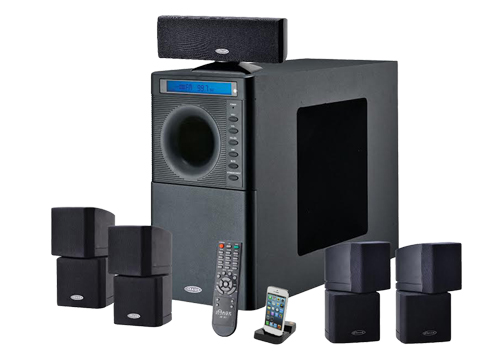
Montage Acoustics HD9001: Competing media
In the 1940s two new broadcast media evolved in the US which competed with AM: FM radio and television. By the 1950s, the dominance of AM radio over home entertainment was ended. Television replaced AM radio as an evening family pastime; instead of sitting and listening to the radio, families would watch television. By the 1970s FM radio, due to its superior audio quality, attracted serious audiophiles.
Consumer use of FM transmitters
In some countries, small-scale (Part 15 in United States terms) transmitters are available that can transmit a signal from an audio device (usually an MP3 player or similar) to a standard FM radio receiver; such devices range from small units built to carry audio to a car radio with no audio-in capability (often formerly provided by special adapters for audio cassette decks, which are becoming less common on car radio designs) up to full-sized, near-professional-grade broadcasting systems that can be used to transmit audio throughout a property. Most such units transmit in full stereo, though some models designed for beginner hobbyists may not. Similar transmitters are often included in satellite radio receivers and some toys.
Legality of these devices varies by country. The U.S. Federal Communications Commission and Industry Canada allow them. Starting on 1 October 2006 these devices became legal in most countries in the European Union. Devices made to the harmonised European specification became legal in the UK on 8 December 2006.Montage Acoustics reviews
Montage Acoustics: AM "radiotelephone" transmission
The entrepreneurs who developed AM "radiotelephone" transmission did not anticipate broadcasting voice and music into people's homes. The term "broadcasting", borrowed from agriculture, was coined for this new activity (by either Frank Conrad or RCA historian George Clark) around 1920. Prior to 1920 there was no concept of "broadcasting", or that radio listeners could be a mass market for entertainment. Promoters saw the practical application for AM as similar to the existing communication technologies of wireless telegraphy, telephone, and telegraph: two-way person-to-person commercial voice service, a wireless version of the telephone. Although there were a number of experimental broadcasts during this period, these were mostly to provide publicity for the inventor's products. True radio broadcasting didn't begin until around 1920, when it sprang up spontaneously among amateur stations. AM remained the dominant method of broadcasting for the next 30 years, a period called the "Golden Age of Radio", until FM broadcasting started to become widespread in the 1950s. AM remains a popular, profitable entertainment medium today and the dominant form of broadcasting in some countries such as Australia and Japan.
Montage Acoustics BT4480
Stereo broadcasts
It is important that stereo broadcasts be compatible with mono receivers. For this reason, the left (L) and right (R) channels are algebraically encoded into sum (L+R) and difference (L-R) signals. A mono receiver will use just the L+R signal so the listener will hear both channels through the single loudspeaker. A stereo receiver will add the difference signal to the sum signal to recover the left channel, and subtract the difference signal from the sum to recover the right channel.
The (L+R) Main channel signal is transmitted as baseband audio in the range of 30 Hz to 15 kHz. The (L-R) signal is modulated onto a 38 kHz double-sideband suppressed-carrier (DSB-SC) signal occupying the baseband range of 23 to 53 kHz.
A 19 kHz pilot tone, at exactly half the 38 kHz sub-carrier frequency and with a precise phase relationship to it, as defined by the formula below, is also generated. This is transmitted at 8–10% of overall modulation level and used by the receiver to regenerate the 38 kHz sub-carrier with the correct phase.
The final multiplex signal from the stereo generator contains the Main Channel (L+R), the pilot tone, and the sub-channel (L-R). This composite signal, along with any other sub-carriers, modulates the FM transmitter. Montage Acoustics
Montage Acoustics HD9001:Quadraphonic FM
In 1969 Louis Dorren invented the Quadraplex system of single station, discrete, compatible four-channel FM broadcasting. There are two additional subcarriers in the Quadraplex system, supplementing the single one used in standard stereo FM. The baseband layout is as follows:
50 Hz to 15 kHz Main Channel (sum of all 4 channels) (LF+LR+RF+RR) signal, for mono FM listening compatibility.
23 to 53 kHz (cosine quadrature subcarrier) (LF+LR) - (RF+RR) Left minus Right difference signal. This signal's modulation in algebraic sum and difference with the Main channel was used for 2 channel stereo listener compatibility.
23 to 53 kHz (sine quadrature 38 kHz subcarrier) (LF+RF) - (LR+RR) Front minus Back difference signal. This signal's modulation in algebraic sum and difference with the Main channel and all the other subcarriers is used for the Quadraphonic listener.
61 to 91 kHz (cosine quadrature 76 kHz subcarrier) (LF+RR) - (LR+RF) Diagonal difference signal. This signal's modulation in algebraic sum and difference with the main channel and all the other subcarriers is also used for the Quadraphonic listener.
95 kHz SCA subcarrier, phase-locked to 19 kHz pilot, for reading services for the blind, background music, etc.
